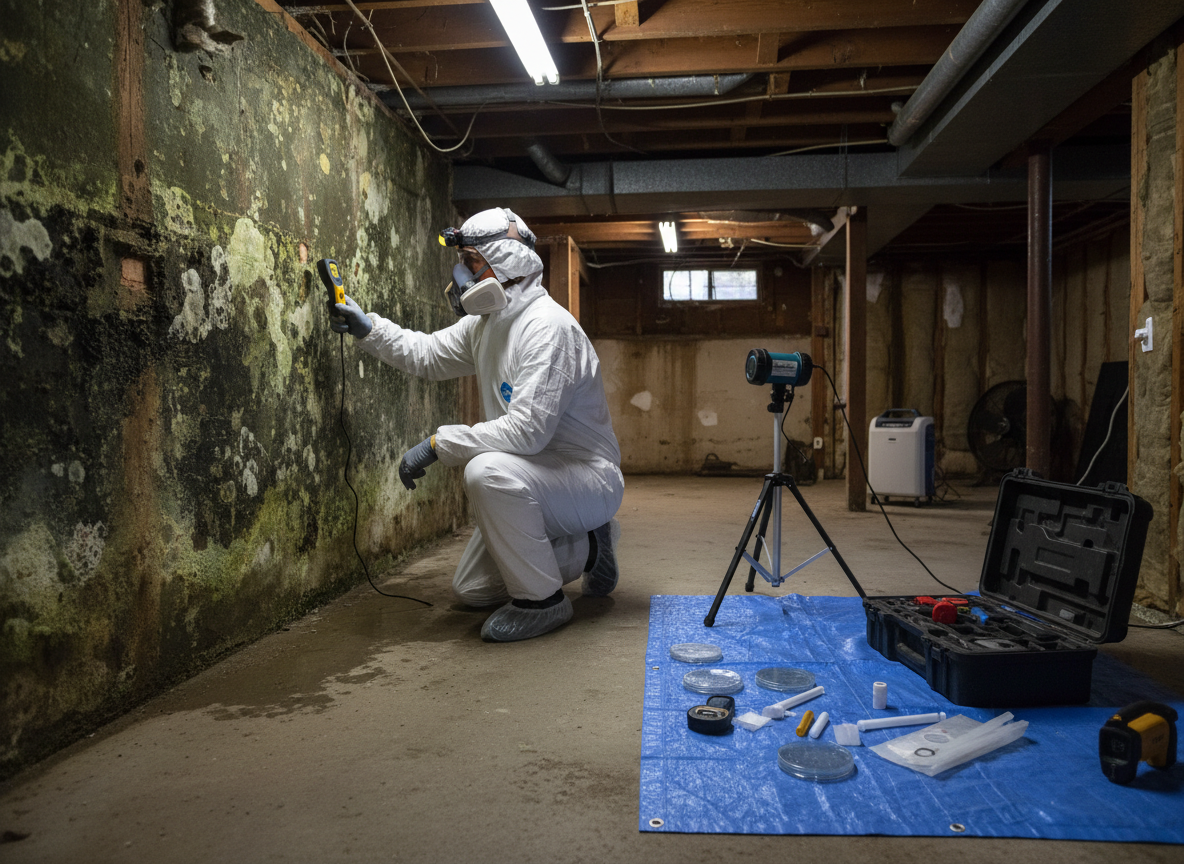
San Luis Rey homes often feature older concrete basements built before current drainage standards, especially properties along Mission Avenue and near the historic mission. These foundations absorb moisture from seasonal coastal fog and occasional heavy winter rains that pool against slab edges. A proper inspection maps every cold joint, utility penetration, and sump area where water migrates upward through the slab. Technicians use moisture meters and infrared to locate hidden damp zones that visual checks miss in these older builds.
Edge cases here include finished basements converted from garages in the 1970s and 1980s stock common around San Luis Rey. Sheetrock installed directly against concrete traps vapor and allows growth behind base plates. Inspectors must pull trim and check under stairs or HVAC returns where airflow pushes spores into living spaces. Air sampling is taken at multiple heights because temperature stratification in these low-ceiling basements keeps spores suspended near the floor.
San Diego County building codes require documentation of moisture sources before any remediation permit is issued. Homeowners who skip inspection risk repeated callbacks when grading issues or cracked perimeter drains are left unaddressed. We always note soil contact points and recommend exterior fixes that actually solve the water entry rather than masking symptoms with dehumidifiers alone.
Technician insight
In San Luis Rey, the thing that catches most people out with Basement mold inspection is the high water table along the San Luis Rey River corridor combined with older homes that have no perimeter drain tile. Homeowners assume a musty smell means just a dehumidifier, but the real issue is often water wicking up through the slab edge where the original grading was never corrected.
Slab-Edge Growth in Mission Avenue Home
A homeowner near 4050 Mission Ave reported a persistent odor after winter rains. Inspection revealed elevated moisture at the basement slab perimeter where the yard sloped inward. Air samples confirmed mold behind the finished wall base. We documented the grading issue and provided a targeted remediation plan that addressed both the growth and the water source.
How it works
- 1
Site Walk and Access Review
We examine every accessible basement wall, floor, and ceiling while noting finished versus unfinished areas typical in San Luis Rey homes.
- 2
Moisture Mapping
Infrared and pin meters locate damp zones behind drywall and under flooring without demolition.
- 3
Air and Surface Sampling
Samples are collected from multiple basement zones and compared to outdoor baselines to confirm active growth.
- 4
Written Report and Source Identification
Findings include photos, moisture readings, and specific recommendations tied to the property's grading and drainage realities.
Pricing
Inspection pricing reflects square footage, finished versus unfinished space, and any access constraints common in older San Luis Rey basements.