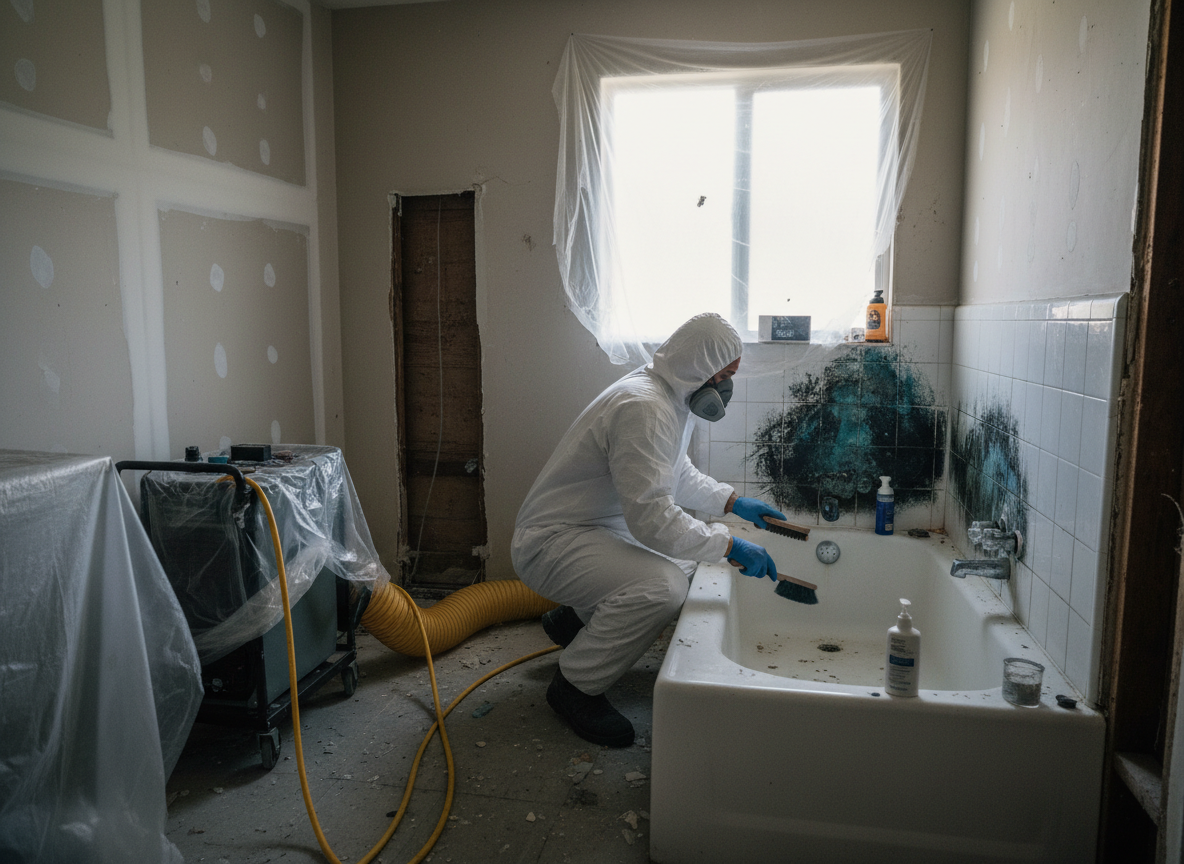
Bathrooms in San Luis Rey homes built before the 1990s often hide mold behind tile and in wall cavities because original cast-iron or galvanized pipes develop pinhole leaks that go unnoticed until staining appears on drywall. Coastal air from the nearby Pacific keeps indoor humidity elevated even in winter, so exhaust fans that vent only into attics rather than outside allow moisture to linger. Technicians begin by isolating the room with plastic sheeting and negative air machines to prevent spores from migrating into hallways or adjacent bedrooms during demolition.
Once the source is located, affected drywall, baseboards and insulation are cut out at least twelve inches past visible growth to reach dry substrate. Antimicrobial rinses are applied to joists and subflooring, followed by HEPA vacuuming and moisture meter checks to confirm readings stay below fifteen percent. In many Mission Avenue corridor properties, the job also includes replacing water-damaged vanity backsplashes or re-sealing grout lines that cracked from repeated expansion during the rainy season.
Final steps focus on prevention tailored to local conditions: upgrading the bath fan to a humidity-sensing model that runs until levels drop, adding a small dehumidifier in homes without central air, and advising owners to run the fan for twenty minutes after showers. These measures reduce recurrence in the mild but persistently damp San Luis Rey microclimate where fog can linger into late morning.
Technician insight
In San Luis Rey the thing that catches most people out with bathroom mold removal service is hidden rot behind the original 1970s tile in homes along Mission Avenue where the shower pan was never properly flashed; coastal humidity keeps the wood damp long after the leak stops, so the job always expands once the tile comes off.
Hidden Leak Behind Shower Tile
Owner in a 1978 San Luis Rey house noticed musty smell after winter rains. Inspection revealed water migrating from a cracked shower pan joint into the subfloor and wall cavity. Crew removed the tile and drywall, treated the framing, replaced the pan with a pre-sloped liner, and installed a humidity-sensing fan. The space passed final moisture checks with no recurrence after three months.
How it works
- 1
On-Site Assessment
Technician inspects all bathroom surfaces, uses moisture meters on walls and floors, and identifies the leak source without disturbing mold.
- 2
Containment and Removal
Room is sealed with plastic barriers and negative air flow; affected materials are removed and bagged for disposal following IICRC protocols.
- 3
Cleaning and Drying
Exposed framing receives antimicrobial treatment, then industrial air movers and dehumidifiers dry the space to under fifteen percent moisture.
- 4
Restoration and Prevention
New moisture-resistant drywall and fixtures are installed; ventilation upgrades and sealant recommendations are provided before final walkthrough.
Pricing
Pricing varies by square footage affected, depth of hidden growth, and any needed ventilation upgrades.