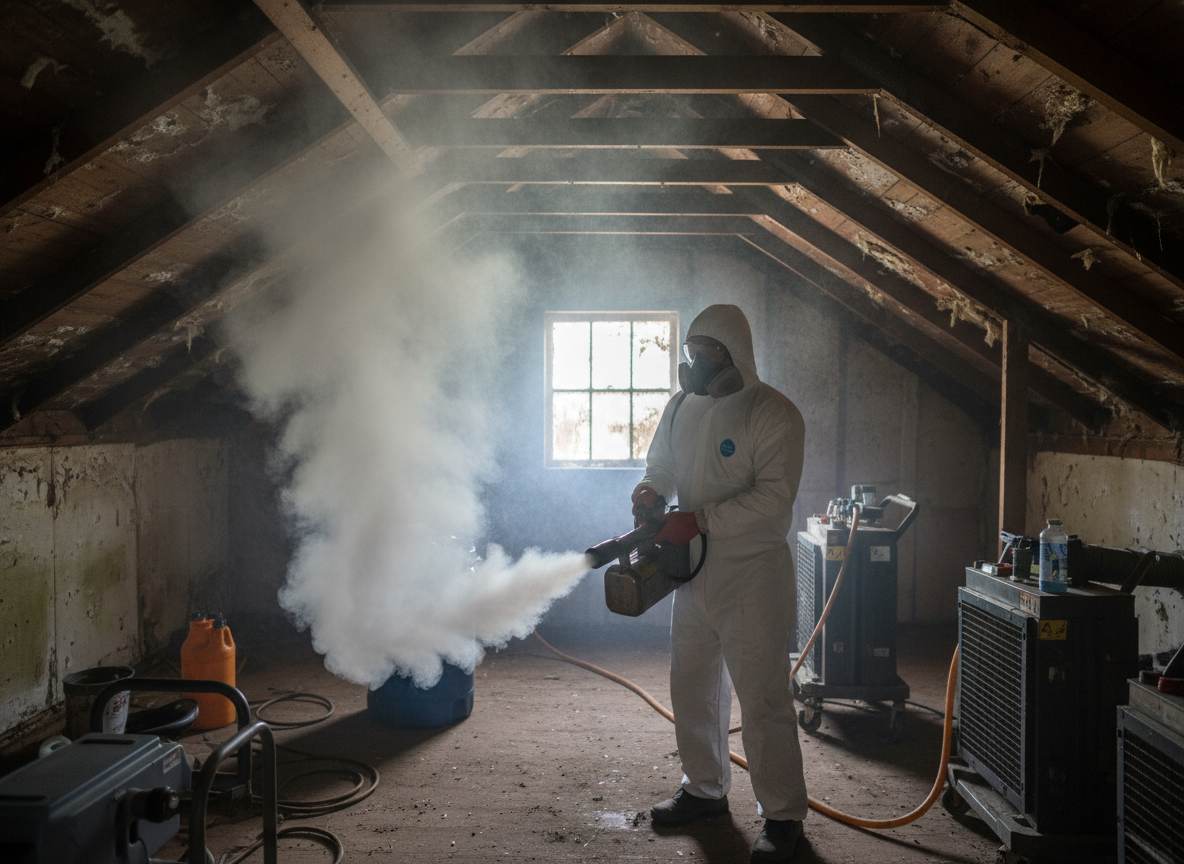
Mold fogging treatment disperses EPA-registered antimicrobials as a fine mist to reach hidden surfaces in attics, wall cavities, and crawl spaces common in San Luis Rey's older single-family homes built before 1980. These structures often feature unvented crawl spaces that trap moisture from the San Luis Rey River floodplain, allowing spores to circulate through HVAC systems. The process requires shutting down the HVAC, sealing registers, and using negative air machines to prevent cross-contamination into living areas. Technicians must calculate dwell time based on room volume and humidity levels, which stay elevated during the region's marine layer events.
Edge cases include properties with stucco exteriors along Mission Avenue where water intrusion behind the cladding creates hidden reservoirs that fogging alone cannot fully address without first opening walls. In multi-unit buildings near the 4050 Mission Ave corridor, shared attic spaces demand coordinated treatment across units to avoid recontamination. Fogging does not replace physical removal of visible growth or saturated materials, and post-treatment verification with air sampling is essential before reoccupancy. Homeowners should expect temporary evacuation for 24 to 48 hours depending on ventilation rates after the fog settles.
San Diego County building codes require proper containment and disposal of any removed materials during mold work, even when fogging is the primary method. Over-application risks damaging electronics and fabrics, so calibrated equipment and PPE are mandatory. Fogging is most effective after source moisture has been corrected, such as fixing roof leaks or improving grading around foundations in the low-lying San Luis Rey neighborhoods prone to seasonal runoff.
Technician insight
In San Luis Rey the thing that catches most people out with mold fogging treatment is the older crawl spaces along the river corridor where the marine layer keeps relative humidity high long after the fog machine leaves. Homeowners often skip fixing the grading around the foundation first, so spores return within weeks.
Crawl Space Treatment After River Flooding
A single-story home near Mission Avenue showed elevated spores after winter runoff. Inspection revealed moisture trapped under the floor joists from the nearby San Luis Rey River. We contained the crawl space, applied fog through access points, then ventilated and sampled. Spore counts dropped below outdoor baselines and the homeowner reported no recurrence after correcting exterior drainage.
How it works
- 1
Initial Assessment
Technicians inspect the property from the 4050 Mission Ave base, identifying moisture sources and spore distribution in San Luis Rey homes.
- 2
Containment Setup
Plastic barriers and negative air machines isolate affected zones to prevent spores from spreading to clean areas.
- 3
Fog Application
Antimicrobial fog is released into contained spaces, allowing particles to settle on all surfaces including hidden cavities.
- 4
Ventilation and Verification
Air is exchanged and cleared before air sampling confirms spore reduction meets safe thresholds for reentry.
Pricing
Pricing varies by square footage treated, number of rooms, and whether HVAC cleaning is required alongside fogging.