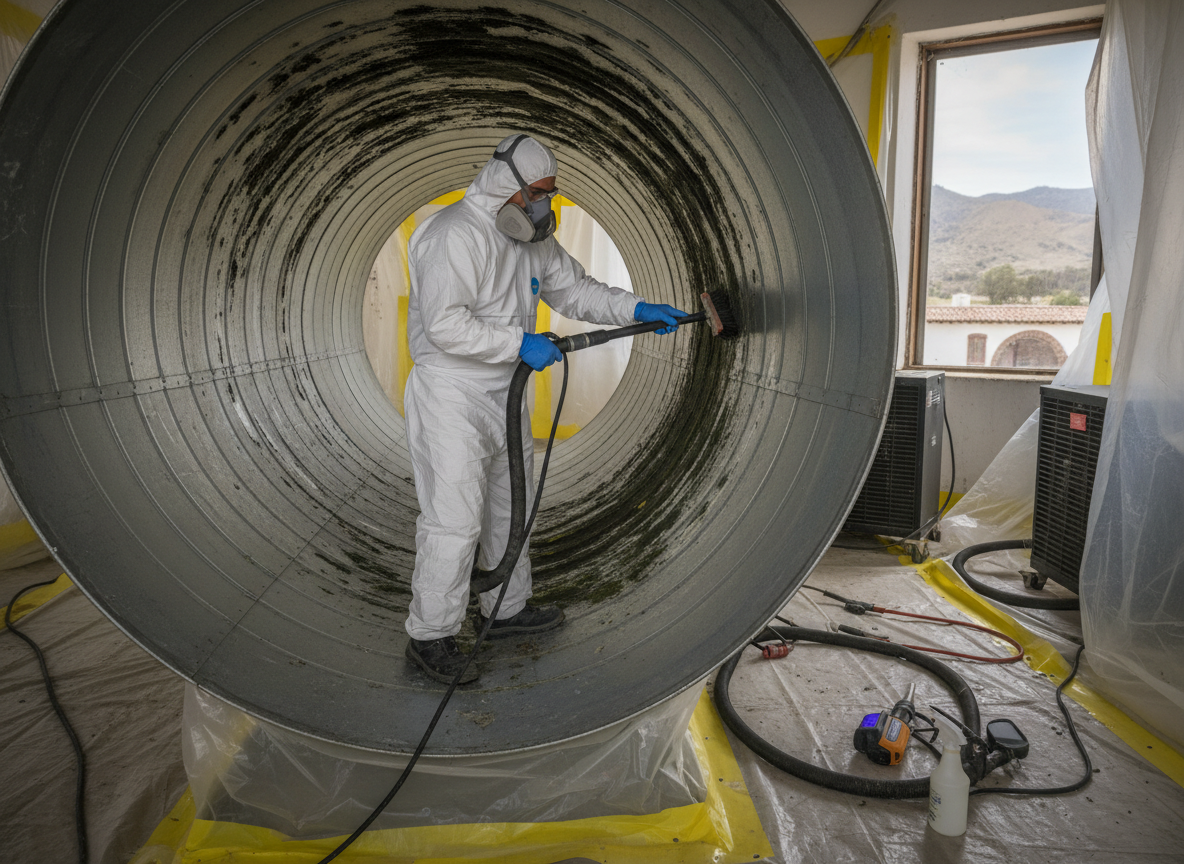
Ventilation mold remediation in San Luis Rey requires isolating affected duct runs and return air paths before any disassembly. Older housing stock along Mission Avenue and nearby streets often features flex duct and metal trunk lines installed before current moisture standards, allowing condensation to collect where coastal air mixes with inland heat. Technicians must map every register and inspect attic and crawlspace transitions, because spores travel through the entire system once a single section is disturbed.
Access limitations in San Luis Rey homes frequently force the use of remote cameras and negative-air machines rather than full duct replacement. Soil conditions near the San Luis Luis Rey River can raise humidity levels in crawlspaces, pushing moisture into floor joist cavities that connect to supply lines. Any remediation plan must account for these paths, or residual growth reappears within a single cooling season when the system cycles on.
Clearance testing after ventilation mold remediation includes both surface and air sampling at multiple points in the home. San Diego County building practices in the area sometimes leave uninsulated ducts in attics exposed to temperature swings, creating repeated condensation cycles that the remediation must address through targeted cleaning and sealing rather than blanket fogging.
Technician insight
In San Luis Rey the thing that catches most people out with ventilation mold remediation is how often the flex duct runs hidden above dropped ceilings in 1970s and 1980s homes along Mission Avenue trap moisture from the nearby river corridor; homeowners think cleaning the registers is enough but the real growth sits in those sagging lines where temperature swings keep creating condensation.
Attic Duct Growth After Roof Leak
A San Luis Rey homeowner noticed musty air from ceiling vents after a roof repair. Inspection found condensation and mold inside the main trunk line where attic insulation had been disturbed. We isolated the system, removed the contaminated flex sections, cleaned the metal runs, and verified clearance before reconnecting the HVAC.
How it works
- 1
Initial Containment
Set up negative air machines and seal off HVAC zones to prevent spore migration during inspection.
- 2
System Mapping and Inspection
Use cameras and moisture meters to locate all affected duct sections, registers, and return paths in the San Luis Rey property.
- 3
Source Removal
Clean or remove contaminated flex duct, clean metal trunks with HEPA vacuum and antimicrobial agents, and treat connected plenums.
- 4
Drying and Verification
Dry all surfaces, then perform post-remediation air and surface sampling before restoring system operation.
Pricing
Cost depends on the number of affected runs, accessibility of attic and crawlspace ducts, and whether flex sections require replacement.