2026-10-22 ·
How Coastal Fog Affects Mold Growth in San Luis Rey Homes
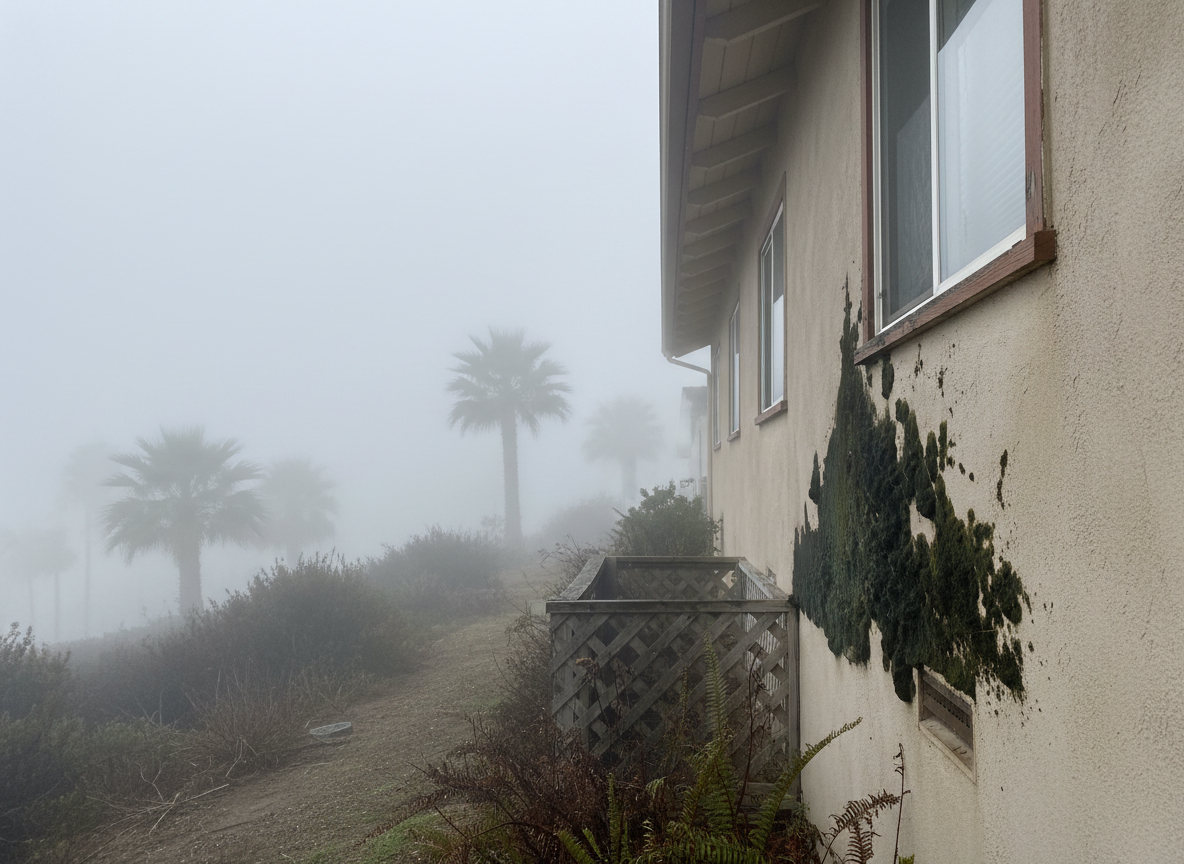
Coastal fog lifts humidity inside San Luis Rey homes by 15-25 percent on typical summer mornings, allowing mold colonies to start on drywall or wood within 24-48 hours once moisture lingers above 60 percent relative humidity. The marine layer that rolls in from the Pacific most nights between May and October keeps surfaces cooler than the air, so condensation forms on north-facing walls, window frames, and attic sheathing even when outdoor rain totals stay low.
Marine Layer Patterns in San Luis Rey
San Luis Rey sits in the coastal zone of San Diego County where the marine layer forms almost nightly from late spring through fall. Fog usually arrives between 10 pm and 2 am and burns off by late morning, yet the trapped moisture remains in crawl spaces and attics long after the sun appears. Homes built before 1970 along Mission Avenue and nearby streets often lack modern vapor barriers, so repeated dew-point events soak insulation and framing. The same pattern repeats in Vista and Oceanside neighborhoods just east of the 5 freeway, where slightly warmer days still leave enough overnight cooling for condensation to occur.
Condensation Points Common in Local Housing Stock
Single-story ranch homes and two-story tract houses from the 1950s-1980s dominate San Luis Rey. These structures feature vented attics with minimal insulation and crawl spaces that sit close to the soil. When fog raises outdoor humidity, the temperature difference between the cool attic deck and warmer living space pulls moisture upward through ceiling penetrations. Bathroom exhaust fans that terminate in attics rather than through the roof compound the problem by adding warm, moist air directly into the condensation zone. Kitchens with older range hoods show similar patterns above cabinets and along exterior walls.
Homeowners notice dark staining first on north-facing bedroom walls and inside closets that stay closed during the day. In crawl spaces, the same fog-driven moisture combines with soil evaporation to keep joists and subfloor above 16 percent moisture content for weeks at a time.
How Fog-Related Mold Differs from Rain or Plumbing Leaks
Unlike a sudden pipe burst that produces visible water, fog-related growth spreads slowly across large surface areas. It often appears as a thin, powdery coating on oriented-strand-board sheathing or as musty odors in closed rooms. Because the source is ongoing humidity rather than a single event, the affected zone can stretch from the attic down through wall cavities into the crawl space. Testing air samples from multiple levels reveals elevated spore counts that drop only after both the humidity source and existing growth are addressed.
For a thorough assessment of hidden growth, many residents schedule mold inspection that includes moisture mapping and thermal imaging across the full height of the structure.
Practical Steps for San Luis Rey Homeowners
Reducing the impact starts with improving attic ventilation and sealing ceiling penetrations so moist air cannot rise. Installing a sealed crawl-space vapor barrier and a small dehumidifier keeps soil moisture from adding to the fog load. Running bathroom fans for 20 minutes after showers and ensuring they vent directly outdoors prevents additional humidity spikes during the fog season. Checking window condensation each morning and wiping sills before moisture soaks into drywall frames helps limit surface growth.
Older construction often needs targeted upgrades; see handling mold found in older San Luis Rey construction for details on common framing details and remediation sequences. Preventing recurrence in high-moisture rooms is covered in preventing mold in San Luis Rey kitchens and bathrooms.